
Beyond the Switcher: How AI Redefines the Modern Broadcast Control Room
The Manual Burden in Traditional Sports Production
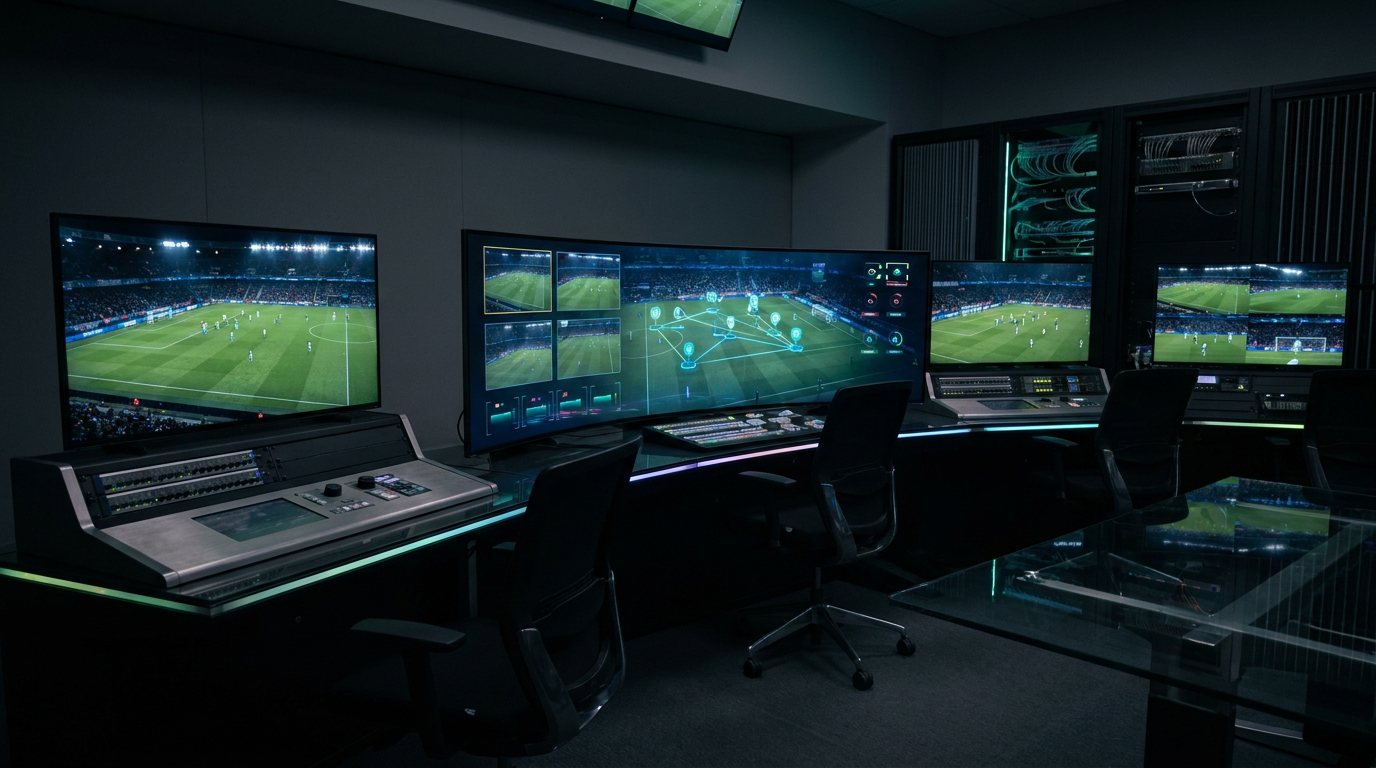
In the heart of any live sports broadcast lies the control room—a high-pressure environment where split-second decisions determine the viewer's experience. For decades, this has been a fundamentally manual operation. A director, surrounded by a wall of monitors displaying dozens of camera feeds, must instantly select the most compelling shot, cue graphics, coordinate replays, and guide the narrative of the game. This process is both an art and a monumental technical challenge.
The cognitive load on a production team is immense. The risk of missing a key moment, a subtle player interaction, or a critical play is constant. This manual overload often forces crews into a reactive posture, focused solely on keeping up with the action rather than elevating it. The result is a production workflow that is not only resource-intensive and prone to human error but also creatively constrained. As the number of camera angles, data streams, and distribution platforms grows, this manual paradigm becomes increasingly unsustainable, limiting a broadcaster's ability to scale operations and innovate their content offerings.
AI's Role in Automating Core Production Tasks
AI broadcast production automation introduces a new layer of intelligence to this environment, capable of offloading the most repetitive and demanding tasks. By leveraging advanced computer vision and machine learning, AI platforms can analyze every video feed in real-time, understanding the context of the game with near-human perception. This enables the automation of several core functions that traditionally require constant manual intervention.
These automated capabilities include:
- Intelligent Camera Switching: AI can analyze player positions, ball trajectory, and game state to autonomously select the best camera angle, mimicking the decisions of an expert human director. It ensures the main broadcast feed is always focused on the most relevant action.
- Automated Graphics and Overlays: Based on in-game events detected by the AI (like a goal, a foul, or a specific player milestone), relevant graphics can be triggered and displayed automatically, ensuring timely and accurate information for the viewer without manual cueing.
- Real-Time Highlight Clipping: AI systems can identify significant moments—goals, saves, impressive plays—and instantly clip them into shareable highlights. This dramatically accelerates content creation for social media, halftime shows, and post-game summaries.
- Player and Object Tracking: By continuously tracking every player on the field, AI provides the foundational data needed for automated camera direction and advanced statistical analysis, creating a richer dataset for storytelling.
From Reactive Switching to Proactive Storytelling
The true value of AI broadcast production automation is not just efficiency; it is the fundamental shift it enables in the creative process. By automating the mechanics of production, AI liberates the human director and producer from the tyranny of the switcher. Their focus can evolve from making thousands of minute, repetitive decisions to overseeing the broader narrative of the broadcast.
Instead of being heads-down, reacting to the immediate play, the production team can adopt a more strategic, 'heads-up' approach. They can concentrate on higher-value tasks: crafting compelling storylines, identifying emerging player narratives, and choreographing more sophisticated broadcast elements. The director becomes a genuine storyteller, using the automated system as a powerful tool. They can trust the AI to handle the baseline coverage, allowing them to anticipate the flow of the game, prepare for pivotal moments, and add a layer of creative nuance that only human insight can provide. This leads to a more engaging, polished, and dynamic broadcast for the audience.
Where 4D Sight Fits: Intelligent Automation for Live Sports
This transition from manual labor to strategic oversight is where 4D Sight's technology excels. Our platform is built to solve the core challenge of manual production overload by providing a sophisticated layer of AI-driven intelligence. At the heart of our offering is the AI Director, a product that epitomizes the power of AI broadcast production automation.
The AI Director ingests multiple camera feeds and uses our proprietary computer vision models to understand the live game action in real-time. It autonomously operates the production switcher, cutting between cameras to produce a network-quality broadcast feed without direct human intervention. This AI-powered solution doesn't replace the production team; it empowers them. While the AI Director handles the primary game coverage, the human director can focus on integrating custom graphics, calling for specific non-standard shots, or managing pre-produced content packages. It allows broadcasters to produce high-quality coverage for a wider range of events, scale their content output, and ensure their most valuable creative talent is focused on what matters most: creating a memorable fan experience.
Integrating Automation into Existing Broadcast Infrastructure
For any enterprise-level broadcaster, adopting new technology cannot come at the cost of disrupting established, mission-critical workflows. A primary concern is how a complex AI system integrates with millions of dollars of existing broadcast hardware. Modern AI broadcast production automation platforms are designed with this reality in mind.
Rather than requiring a complete overhaul, leading solutions like 4D Sight are engineered for seamless integration. They are compatible with standard industry protocols and hardware, including both traditional SDI and modern IP-based (SMPTE ST 2110) infrastructures. The AI system effectively acts as an intelligent control layer, sending standard commands to the existing production switcher, graphics engine, and replay servers that your team already uses. This approach minimizes implementation friction, reduces the need for extensive retraining, and allows broadcasters to leverage the power of AI without abandoning their current technology stack. It ensures that automation enhances, rather than replaces, the reliable infrastructure that powers live television.
By transforming the control room into a hub of creative strategy rather than manual execution, AI broadcast production automation enables broadcasters to not only streamline their operations but also unlock new levels of quality and storytelling. It empowers teams to work smarter, creating more compelling content for more platforms while simultaneously positioning them to meet the evolving demands of the modern sports fan.
Frequently Asked Questions
What is AI broadcast production automation?
AI broadcast production automation uses artificial intelligence, primarily computer vision, to analyze live video feeds from a sports event. It automatically performs tasks traditionally done by a human production crew, such as switching between cameras, inserting graphics, and creating instant highlights.
Does AI replace the role of a human broadcast director?
No, AI is designed to augment, not replace, the human director. It handles the repetitive, moment-to-moment camera switching, freeing the director and production team to focus on higher-level creative tasks like storytelling, narrative development, and managing more complex broadcast elements.
How does AI handle the unpredictability of live sports?
Advanced AI models are trained on thousands of hours of sports footage to understand the rules, patterns, and context of the game. They learn to anticipate action based on player positioning, ball movement, and game situations, allowing them to react instantly and intelligently to unpredictable plays.
What kind of sports are suited for AI automation?
AI automation is highly effective for a wide range of sports with defined fields of play, including soccer, basketball, hockey, and football. The technology can be adapted to the unique dynamics and rules of virtually any sport where video analysis can determine the focus of the action.
Is it difficult to integrate AI automation into an existing broadcast setup?
Leading AI platforms are designed for seamless integration. They work with standard broadcast hardware and protocols (both SDI and IP-based), acting as an intelligent control layer for your existing production switcher and graphics systems. This minimizes disruption and implementation time.
See how 4D Sight turns live video into real-time sports intelligence →