
Beyond Burnout: How Leading Broadcast Teams Use AI to Reclaim Creative Control
The Ceiling of Manual Production
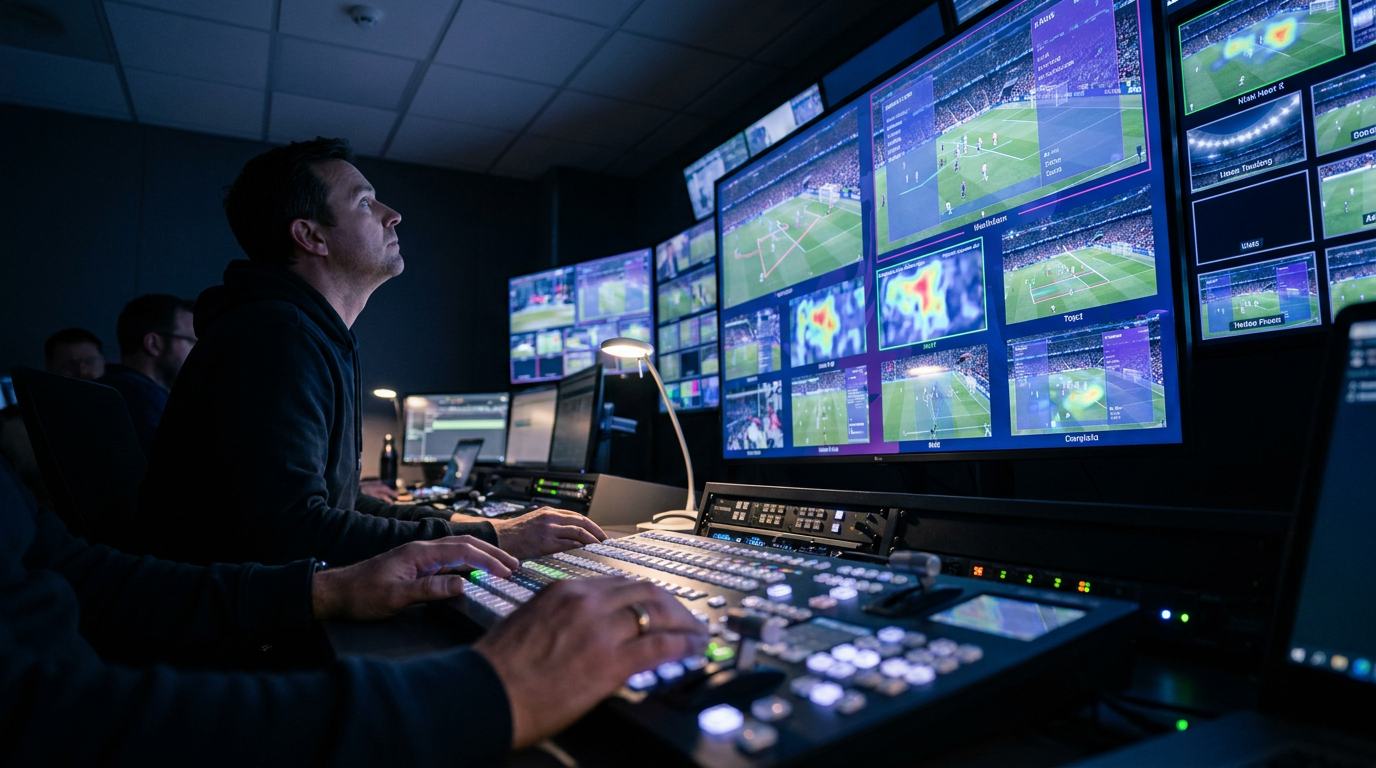
In the high-stakes environment of a live sports broadcast, the pressure on production teams is immense. With an ever-increasing number of camera feeds, distribution channels, and audience engagement platforms, the demand for content has outpaced the capacity of traditional, manual workflows. Teams are stretched thin, focusing more on keeping up with the basic demands of a broadcast than on innovating the fan experience. This constant state of reaction, rather than proaction, creates a ceiling on quality, creativity, and career satisfaction.
This reliance on manual effort introduces significant hidden costs. The most immediate is talent burnout; the repetitive, high-pressure nature of tasks like manual clipping, tagging, and camera switching leads to employee fatigue and high turnover rates. Furthermore, it creates a cascade of missed opportunities. When the entire team is dedicated to servicing the primary broadcast feed, who is creating tailored content for social media, partner apps, or secondary screens? These ancillary channels represent substantial engagement and monetization potential that remains untapped simply due to a lack of human bandwidth. Manual workflows are, by their nature, finite and unscalable.
From Human Operator to AI Orchestrator
The introduction of AI broadcast production automation fundamentally redefines the roles within a production team, shifting responsibilities from rote execution to strategic oversight. This isn't a narrative about replacement, but one of elevation. The technology assumes the most repetitive and data-intensive tasks, freeing human talent to focus on what they do best: storytelling, creative direction, and strategic planning.
Consider the role of a replay operator. In a manual workflow, they are laser-focused on spotting a key play, finding the right angle, and queuing it up in fractions of a second. With an AI assistant, the system can automatically identify every significant play—a goal, a turnover, a foul—and instantly collate the best camera angles. The operator’s role evolves from a reactive technician to a proactive curator. They are no longer just finding the clip; they are choosing from a pre-vetted selection to build a more compelling narrative for the post-game show or a halftime analysis segment. Their expertise is applied to a higher-value task, enhancing the final product rather than just enabling its basic components.
Scaling Content Creation with Context-Aware AI
One of the most powerful applications of AI in broadcasting is the ability to generate derivative content at a scale impossible for human teams. A single live game contains thousands of potential micro-stories, but manually clipping and distributing them is a monumental effort. AI, however, can monitor every camera feed simultaneously and, more importantly, understand the context of the on-field action.
Because the AI is trained on sport-specific data, it recognizes not just an event, but its significance. It can differentiate between a routine pass and a game-changing assist. This contextual understanding allows it to autonomously generate a vast array of assets in near real-time. For instance, upon a goal being scored, the system can instantly create:
- A 10-second vertical clip for Instagram Stories from a sideline camera.
- A 30-second multi-angle replay package for the main broadcast.
- A player-specific highlight showing the entire sequence, for use in a dedicated fan app.
- A branded graphic overlay with the updated score, ready for insertion.
This automated workflow ensures that every distribution channel receives tailored, high-quality content the moment it happens, maximizing audience engagement when excitement is at its peak.
Where 4D Sight Fits: Intelligent Broadcast Automation
The central challenge for modern sports broadcasters is the need to scale content operations without a proportional increase in operational costs or human resources. Manual processes are the bottleneck preventing this growth. 4D Sight provides a sophisticated solution built on advanced computer vision and deep learning, designed to augment production teams and break through this manual barrier.
Our AI Director product acts as an intelligent layer within your production environment. It ingests live video feeds and analyzes the game in real time, identifying key plays, players, and game states with expert-level accuracy. More than simple automation, AI Director makes context-aware decisions. It can autonomously operate a virtual camera to follow the main action, generate instant highlights from the most dramatic angles, and surface critical moments for a human director to review. It functions as a tireless, expert production assistant, handling the high-volume, repetitive work so your team can focus on creative execution and strategic oversight.
Phased Implementation for Seamless Integration
Adopting enterprise-grade AI does not require a disruptive overhaul of your entire production infrastructure. The most successful implementations of AI broadcast production automation begin with a phased approach that targets a specific, high-impact workflow. This strategy minimizes risk and allows the technology to demonstrate tangible value quickly.
For example, a broadcaster might begin by using an AI platform solely for automated highlight generation for their social media channels. The AI can run in parallel with the main production, ingesting feeds and producing clips without interfering with the primary broadcast workflow. Modern platforms like 4D Sight are designed for this flexibility, integrating seamlessly with existing broadcast standards such as SDI and NDI. It functions as an additive layer of intelligence, not a replacement for trusted systems. Once the value is proven—through increased content output, higher engagement, or reduced manual workload—its role can be expanded to other areas like automated camera direction or real-time data graphics.
The goal is to empower your team, not replace it. By offloading the monotonous tasks that lead to burnout, you unlock the full creative and strategic potential of your most valuable asset: your people. The future of sports broadcasting is a collaborative synergy between human expertise and AI efficiency. The teams that embrace this partnership will not only operate more effectively but will also define the next era of engaging and innovative sports media experiences.
Frequently Asked Questions
Does AI broadcast automation replace production staff?
No, the goal of AI automation is to augment production staff, not replace them. It handles repetitive, high-volume tasks, freeing up human operators, directors, and producers to focus on higher-value creative and strategic work like storytelling and curation.
What is the main benefit of using AI for broadcast production?
The primary benefit is scalability and efficiency. AI allows broadcasters to create significantly more content (e.g., highlights, social clips, custom feeds) from live events in real-time than a manual team ever could, while simultaneously reducing the tedious workload on staff.
How does AI like 4D Sight integrate with existing broadcast equipment?
Modern AI platforms are designed for interoperability. They typically integrate with standard broadcast infrastructures by processing common video signals like SDI and NDI, acting as an intelligent software layer that works alongside your existing switchers, replay systems, and graphics engines.
Can the AI understand the rules and actions of different sports?
Yes. Sophisticated AI platforms like 4D Sight are trained on sport-specific models. This enables the AI to recognize the unique actions, game states, and significant events for a wide range of sports, from soccer and basketball to auto racing.
What's the difference between simple automation and AI-powered automation?
Simple automation follows pre-defined, rigid scripts (e.g., 'at the 10-minute mark, run this graphic'). AI-powered automation is dynamic and context-aware; it understands what is happening in the live game and can make intelligent, real-time decisions based on those events.
See how 4D Sight turns live video into real-time sports intelligence →